Basketball Court Dimensions: Half-Court Sizes for Long Island Backyards
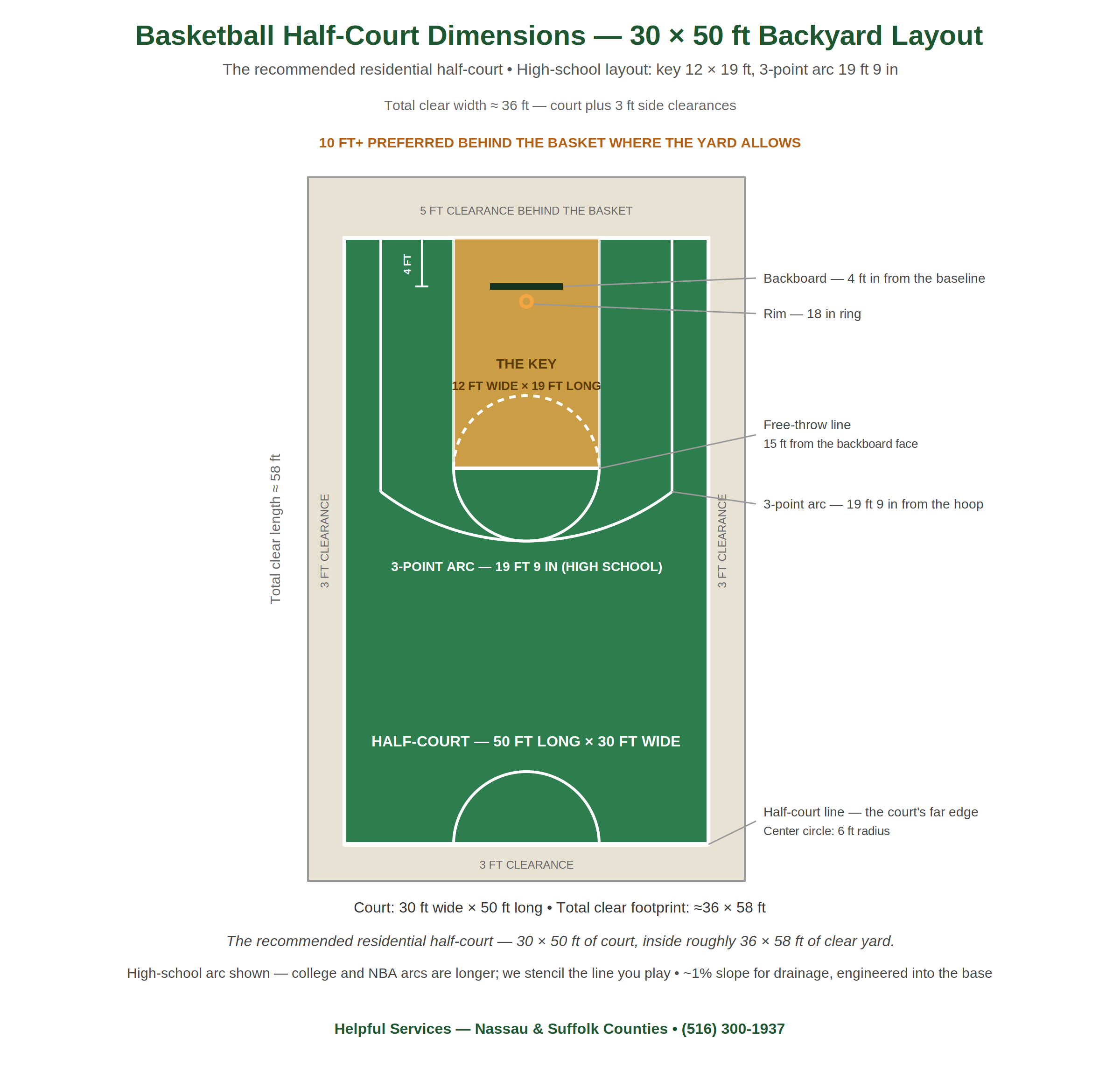
Last updated: November 2026 A regulation half-court is 47×50 feet. The half-court size we recommend and build most for Long…

Last updated: November 2026
Most backyard half-courts on Long Island cost $18,000–$45,000 installed with a modular tile surface over a concrete or asphalt base. A painted asphalt or concrete shooting court starts lower, around $10,000–$20,000 depending on size, and full courts run $60,000–$120,000 or more. The most popular residential size, 30×50 feet, typically runs $28,000–$45,000 in tile.
Free phone consult: (516) 300-1937
Consult hours: Monday–Friday 11 AM–7 PM · Saturday 11 AM–3 PM
No honest builder can price your court from a square-foot number alone, because the base, drainage, access, and slope underneath drive the real cost. What a builder can do — and what almost no Long Island builder does — is publish planning ranges by size and by surface. This is the same table published on our basketball court installation page. All ranges are installed planning ranges for Long Island residential projects. They are not quotes; your written quote follows a property evaluation and is fixed to a defined scope before construction begins.
| Court type | Dimensions | Playing area | Painted asphalt/concrete | Modular tile over concrete or asphalt base | Acrylic over post-tension concrete |
|---|---|---|---|---|---|
| Shooting / key court | 20×25 ft | 500 sq ft | $10,000–$18,000 | $16,000–$26,000 | $20,000–$30,000 |
| Compact half-court | 25×30 ft | 750 sq ft | $12,000–$20,000 | $18,000–$30,000 | $24,000–$36,000 |
| Standard half-court | 30×30 ft | 900 sq ft | $14,000–$24,000 | $20,000–$34,000 | $26,000–$40,000 |
| Standard half-court — most popular | 30×50 ft | 1,500 sq ft | $20,000–$34,000 | $28,000–$45,000 | $36,000–$55,000 |
| Large half-court | 35×58 ft | 2,030 sq ft | $26,000–$42,000 | $36,000–$58,000 | $46,000–$68,000 |
| High school half-court | 42×50 ft | 2,100 sq ft | $28,000–$44,000 | $38,000–$62,000 | $48,000–$72,000 |
| Regulation half-court | 47×50 ft | 2,350 sq ft | $30,000–$48,000 | $40,000–$65,000 | $52,000–$78,000 |
| Full court — high school | 50×84 ft | 4,200 sq ft | $48,000–$78,000 | $60,000–$100,000 | $78,000–$115,000 |
| Full court — NBA / FIBA regulation | 94×50 ft | 4,700 sq ft | $52,000–$85,000 | $70,000–$110,000 | $85,000–$120,000+ |
National cost guides put a backyard basketball court at roughly $12,400–$60,000, with an average near $39,400. Templated town cost sites quote $30,000–$47,500 as a Long Island average. Those numbers are not wrong — they are averaged across court sizes and the whole country. Long Island labour, excavation, drainage, and permit conditions sit at the higher end of national ranges, and a premium tile or post-tension build sits above a painted court of the same size. The table above is how those averages resolve into real Long Island planning numbers, size by size.
Find your size first, then your surface. A family court is usually the 30×50 row; a training court is the 47×50 row or a 30×50 built to the premium column; a tight lot is the 25×30 or 20×25 row — and a well-built small court beats a thin, oversized pad every time. If you do not yet know what size fits your property, read our basketball court dimensions guide before you budget: size mistakes are discovered after the base is poured.
Square-foot figures in national guides are usually component prices, not a finished court. Here is how to read them honestly:
| Component | Published range (per sq ft) | What it covers — and what it does not |
|---|---|---|
| Excavation, aggregate base, and compaction | $3–$10 | The structural foundation. Depth and material vary with soil, slope, and drainage. Never skip or thin this to hit a price. |
| Asphalt slab | $3–$5 | Asphalt material and paving component only, on top of base work. |
| Concrete slab | $6–$10 | Concrete material and placement component only, on top of base work. Reinforcement or post-tensioning is additional. |
| Acrylic sport coating system | Within $3–$17 surfacing range | Primer, resurfacer, cushion coats (if specified), colour coats. Cost depends on coat count and whether cushion layers are included. |
| Modular tile surface layer | +$4–$8 | The tile itself, added on top of a concrete or asphalt base. Tile is a playing surface, not a substitute for a base. |
| Painted lines and striping | +$1.50–$3 | Game lines in one or more colours. Custom logos, contrasting keys, and multi-sport line packages cost more. |
| Overall installed total (national guides) | $4–$16 | A national blended average. Use it for national articles, not for budgeting a Long Island build. |
Two pricing truths worth knowing:
1. Small courts cost more per square foot than large courts. Excavation, mobilisation, the hoop footing, and striping are largely fixed costs. Spread over 500 sq ft they look expensive; spread over 2,000 sq ft they dilute. That is arithmetic, not markup.
2. The cheapest surface on day one is rarely the cheapest court over fifteen years. A painted court needs periodic recoating and crack repair. A tile court needs almost no surface maintenance, and individual damaged tiles can be swapped. Price the court over its life, not just its install week.
What is included in a Helpful Services quote: site evaluation and layout, excavation and base construction as specified, drainage and slope control as specified, the surface system you selected, striping as drawn, the hoop system you selected, defined material specifications in writing, controlled staging and site organisation, and a final walkthrough and inspection before completion. If something is not in the written scope, it is not assumed — by us or by you.
A lower-friction first step: send us your approximate yard dimensions and a photo of the area you have in mind. We will give you a planning range for the sizes that actually fit before anyone schedules a site visit.
A basketball court is new impervious surface, and most Long Island towns and villages regulate it through lot-coverage and setback rules. On a smaller or already heavily improved lot — house, driveway, patio, pool — coverage, not physical space, can be the binding limit on court size. Fence height limits, tall-netting review, and lighting rules (shielding, height, light spill, and stricter design review in dark-sky-sensitive and historic areas, including parts of the East End and several North Shore villages) can each apply. Garden City, Old Westbury, Brookhaven’s villages, and many HOA communities require architectural review for projects of exactly this kind. We check the coverage, setback, and lighting position for your specific address before design is finalised, and state in writing what is filed, by whom, and what approvals are needed. Permit fees are set by the jurisdiction and identified separately in your quote.
Water gets into or under a thin, poorly compacted base. Winter freeze-thaw expands it. Roots from mature trees lift an edge. The slab, stressed and under-supported, cracks. Nearly every failed court we are called to look at traces to one of those causes, and all of them are addressed at build time or not at all. That is the honest reason a Long Island base — excavation to structural depth, aggregate placed and compacted in lifts, reinforcement or post-tensioning where specified — costs more than a national average assumes. The base is the least visible part of your court and the only part that cannot be fixed cheaply later.
A court carries roughly a 1% slope — about 1/8 inch per foot — in one consistent plane: never felt in play, decisive in how fast the court dries and how long it lasts. Where the water goes after it leaves the court matters as much as getting it off — discharge is planned to a safe point on your property, never directed at a neighbour, a foundation, or a septic area. South Shore and waterfront lots, and low lots that collect run-off, need the additional drainage work priced into the table’s ranges.
For the full engineering standard — base construction, surface comparison, hoop guide, and process timelines — see our basketball court installation page for Long Island. For why courts crack and how drainage fails, our pillar page links both of our plain-English guides on base construction and drainage problems.
Most backyard half-courts on Long Island cost $18,000–$45,000 installed with a modular tile surface over a concrete or asphalt base. A painted asphalt or concrete shooting court starts lower, around $10,000–$20,000 depending on size, and full courts run $60,000–$120,000 or more. Excavation, base depth, drainage, access, hoop, and lighting are the main variables. Your written quote follows a site evaluation and is fixed to a defined scope.
A compact 25×30 ft half-court typically runs $18,000–$30,000 with a tile surface. Our most popular 30×50 ft half-court runs $28,000–$45,000 with tile, or $36,000–$55,000 in acrylic over post-tension concrete. Painted surfaces cost less at every size. Regulation 47×50 ft half-courts run $40,000–$65,000 in tile. Size, base, and surface move the number more than any other factors.
Usually because the quotes are not for the same court. Compare the base specification first: excavation depth, aggregate depth and compaction, reinforcement or post-tensioning, and drainage. Then compare what is actually included — hoop model, striping, lighting, netting, permit responsibilities. A low quote that treats modular tile as a substitute for a base, or omits drainage, is not a cheaper court; it is less court. Ask for every specification in writing.
A painted asphalt or concrete court at an honest size. A 20×25 ft shooting court runs $10,000–$18,000 painted, and a 25×30 ft compact half-court runs $12,000–$20,000 painted. The trade-off is maintenance: painted surfaces need periodic recoating and crack attention, so the cheapest install is rarely the cheapest court over fifteen years. What never saves money is thinning the base — that converts savings into a rebuild.
They are priced as itemised options in every quote, because each depends on your court. An in-ground adjustable hoop system with a tempered-glass backboard is a meaningful line item on any build — size it to your court (72-inch boards for courts 30 ft wide and up, 60-inch for compact courts). LED court lighting extends play into the evening and is cheapest when conduit and mounting positions are roughed in during base work. Containment netting at 10–14 ft keeps balls on the court and out of plantings, pools, and neighbouring yards.
Yes, if the phasing is planned from the start. The base, pad, hoop footing, and any lighting conduit belong in phase one — they cannot be added later without tearing up the court. Surface upgrades, lighting fixtures, netting, and multi-sport striping can follow in later phases. What we advise against is the reverse: a premium surface over a budget base. Spend first on what is underneath; it is the only part you cannot redo cheaply.
Tell us your town, the approximate size of the area you have in mind, and who the court is for. We will come back with the layouts that genuinely fit your property, the surfaces we would recommend for your players, and a planning range for each — before any site visit is scheduled.
Call (516) 300-1937 — free phone consult, Monday–Friday 11 AM–7 PM · Saturday 11 AM–3 PM
One more saving to plan for: court lighting roughed in during the base work costs a fraction of retrofitting it later — and a lit court routinely doubles a family court’s used hours. See how we design outdoor lighting on Long Island, and how court lighting integrates with your patio and landscape lighting as one system.
Basketball court installation on Long Island · Basketball court dimensions guide · Pickleball court construction on Long Island · Bocce court construction on Long Island · Contact Helpful Services