Basketball Court Dimensions: Half-Court Sizes for Long Island Backyards
Last updated: November 2026 A regulation half-court is 47×50 feet. The half-court size we recommend and build most for Long…
Last updated: November 2026
A regulation half-court is 47×50 feet. The half-court size we recommend and build most for Long Island backyards is 30×50 feet — a full high-school 3-point arc and key fit, with real run-off. The minimum for a true half-court game is 25×30 feet, and a shooting court fits in 20×25 feet. Add 3–5 feet of clear run-off beyond the lines when you measure.
Consult hours: Monday–Friday 11 AM–7 PM · Saturday 11 AM–3 PM
Every backyard size below is a scaled decision from these standards. This is the same chart published on our basketball court installation page:
| Layout | Court size | 3-point line | Free-throw line | Best fit |
|---|---|---|---|---|
| NBA regulation (full) | 94×50 ft | 23 ft 9 in (22 ft in corners) | 15 ft from backboard face | Regulation full-court play; very large estate lots |
| FIBA regulation (full) | 91 ft 10 in × 49 ft 2.5 in | 22 ft 1.5 in | 15 ft from backboard face | International-spec builds |
| High school regulation (full) | 84×50 ft | 19 ft 9 in | 15 ft from backboard face | Full-court family and training use where the lot allows |
| Junior high (full) | 74×42 ft | 19 ft 9 in | 15 ft from backboard face | Smaller full-court alternative |
| Regulation half-court | 47×50 ft | Full arc fits | Full key fits | Serious training, near-regulation half-court game |
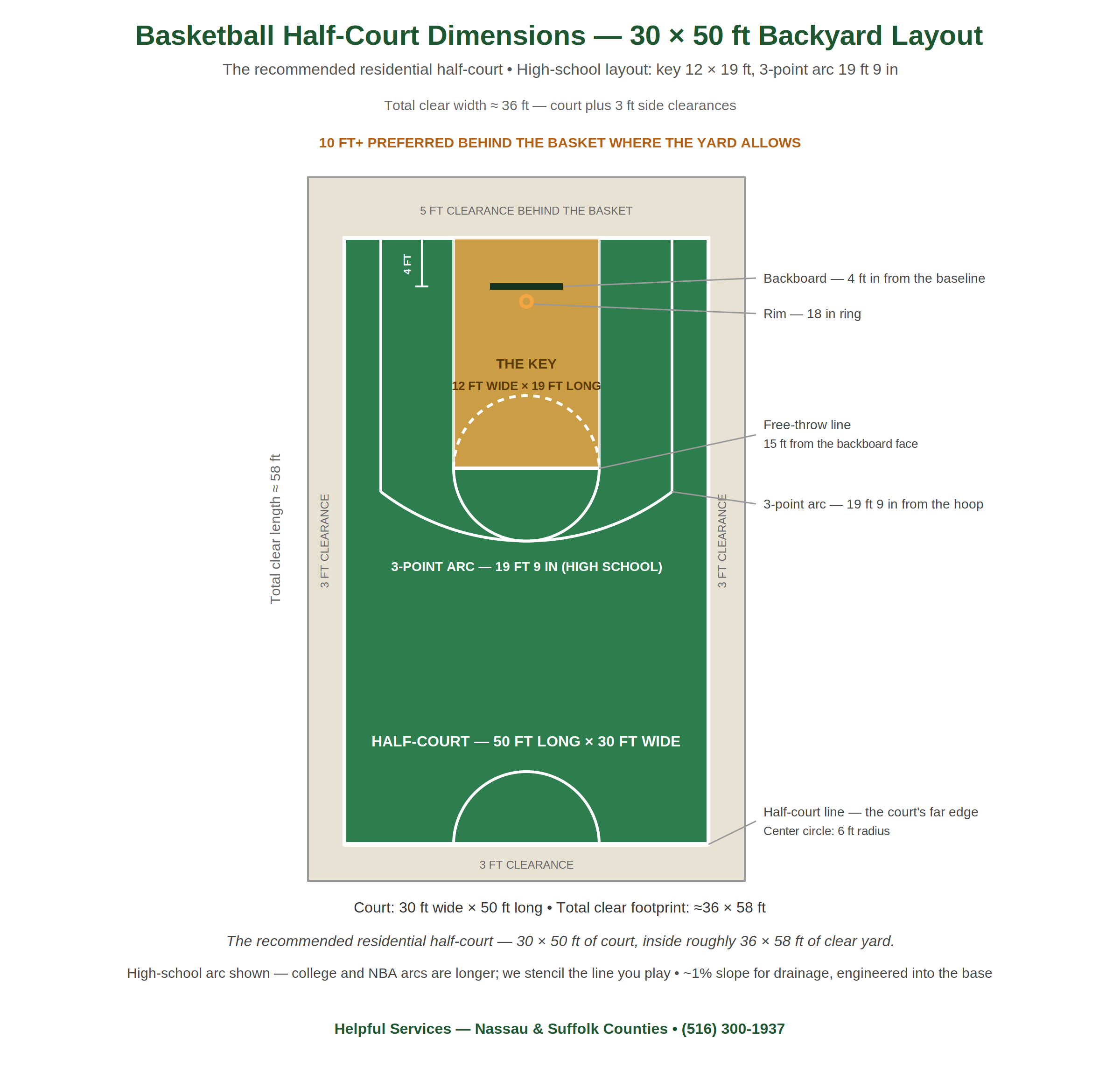
Two reference points explain most backyard decisions. The free-throw line is always 15 feet from the face of the backboard — that distance, plus the key, is the fixed core of any half-court. And the high-school 3-point line at 19 ft 9 in is the arc most family and training courts are drawn around, because it is the line most school-age and adult recreational players actually shoot from.
| Layout | Court size | What fits | Best fit |
|---|---|---|---|
| Shooting / key court | 20×25 ft | Key and elbow work; training marks only (no full arc) | Tight lots, young players, a dedicated practice pad |
| Minimum viable half-court | 25×30 ft | Full key; partial / training arc | Compact lots — an honest training and family court |
| Standard residential half-court | 30×30 ft to 30×35 ft | Full key; high-school arc fits with the hoop offset as drawn | Most family courts — shooting, 1-on-1 to 3-on-3 |
| Recommended residential half-court | 30×50 ft | Full high-school arc and full key, with real run-off | Our most recommended layout — a true half-court game |
| Regulation half-court | 47×50 ft | Full arc and key at regulation scale | Serious training, near-regulation half-court play |
Start with who plays, not with the biggest number that fits. A court for a 9-year-old learning to shoot and a court for a high-school player training daily are different instruments. The 20×25 shooting court serves the first honestly. The second needs the full arc — which means the 30×50.
The arc is the dividing line. Below 30×50, the 3-point arc is partial or a training arc — fine for shooting practice and family games, a real limitation for game shots from the corner. If corner threes matter, choose between the 30×50 (full high-school arc) and the 47×50 regulation half.
Width matters as much as length. Drive-and-finish angles, bank-shot geometry, and rebound position all live in the court’s width; a long, narrow court plays like a corridor. Given a choice, take the width.
A smaller court built well beats a bigger court built thin. Base, drainage, and surface standards should not shrink with the court. A correctly built 25×30 will outplay and outlast an underbuilt 35×58 — and leaves budget for the hoop and lighting that make a court get used.
Not sure which size your yard honestly holds? That measurement — court plus clearances plus setbacks — is the first thing we do on a site evaluation for our basketball court builds on Long Island.
The court’s lines are not the court’s footprint. These clearances come straight from our pillar page standard:
Measure the usable area, not the lot: slope, trees, septic fields, and setback limits all subtract from the rectangle on your survey. On a site visit, that is exactly what we measure.
Match the result against the size table: a clear rectangle of 36×58 ft or better puts the recommended 30×50 in play; at roughly 31×38 ft, design the compact 25×30 honestly rather than squeezing lines into space that cannot hold them.
Setbacks and lot coverage. To your town or village, a court is new impervious surface. It generally counts toward allowable lot coverage — and on lots where a house, driveway, patio, and pool already use much of the allowance, coverage can limit court size before physical space does. Side- and rear-yard setbacks from property lines vary by town, village, and zoning district, and fence-height, netting, and lighting rules can apply on top. Villages such as Garden City, Old Westbury, and Brookville, and many HOA communities, add architectural review. We verify the position for your specific address before design is finalised — dimensions chosen without that check are a guess.
Freeze-thaw and drainage shape the build, not the size. Long Island courts crack and heave when water reaches a thin, poorly compacted base and freezes. The dimensions above assume the standard underneath them: excavation to structural depth, aggregate base compacted in lifts, reinforcement or post-tensioning on concrete systems, and that consistent ~1% drainage plane. Orientation matters too — where the property gives a choice, we set the court so shooters are not looking into low afternoon sun, and so the court does not sit in the property’s natural drainage path.
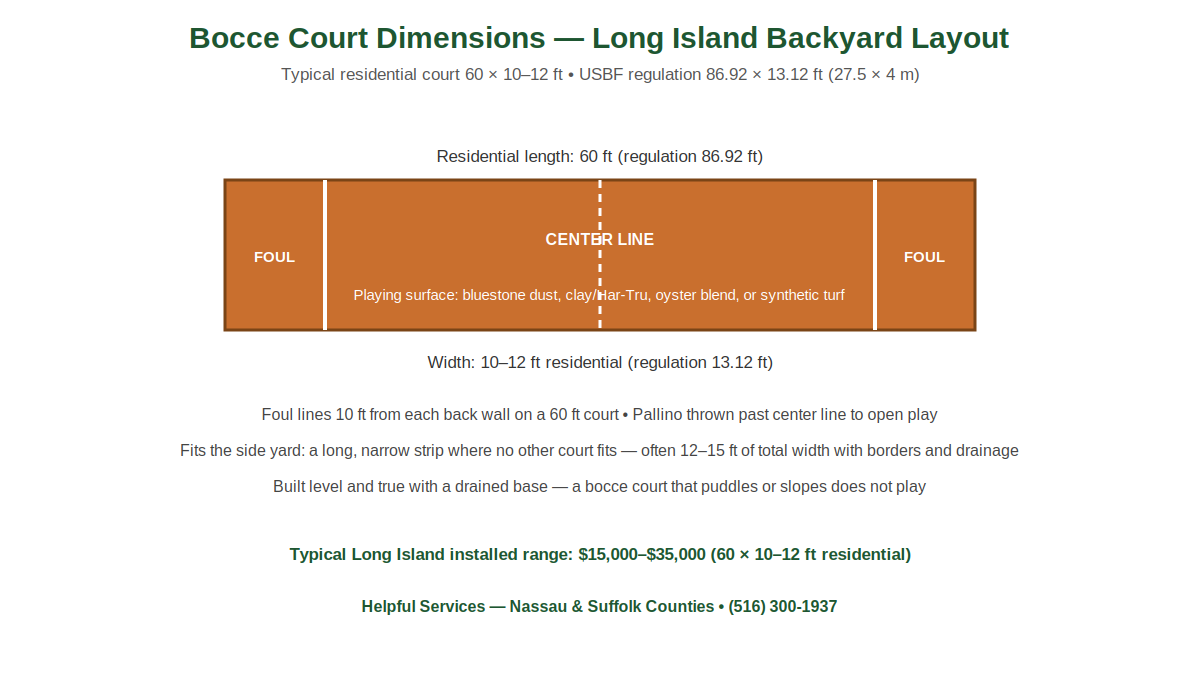
Tight lot? Two honest alternatives. If no half-court rectangle survives the clearance and setback math, a shooting court (20×25 ft) still gives a young player a real practice pad. And on long, narrow side yards, a different sport often fits better: a bocce court needs only a 10–13 ft wide strip. See our bocce court construction page before you give up on a backyard court entirely.
For most families, 30×50 ft is the best layout: a full high-school 3-point arc and key fit, with real run-off. A 30×30 to 30×35 ft court is a strong standard family size, and 25×30 ft is the minimum we recommend for a true half-court game. Regulation half-courts are 47×50 ft, and full high-school courts are 84×50 ft. Add 3–5 ft of clear run-off beyond the lines when you measure your yard.
Measure the court plus its clearances, not just the lines. A 30×50 ft court needs roughly a 36×58 ft clear, reasonably level area once run-off, hoop overhang, and working room are included. A compact 25×30 ft court fits in roughly 31×38 ft. Overhead clearance matters too — no branches or wires over the playing area. On a site visit we measure the actual usable area, including slope, trees, septic, and setback limits.
An NBA court is 94×50 ft, with the 3-point line at 23 ft 9 in (22 ft in the corners). A FIBA court is 91 ft 10 in × 49 ft 2.5 in. A high-school court is 84×50 ft with a 19 ft 9 in 3-point line, and a junior-high court is 74×42 ft. A regulation half-court is 47×50 ft. At every level, the free-throw line sits 15 ft from the face of the backboard.
Usually a compact one, yes. A 25×30 ft half-court — full key, partial training arc — fits in roughly 31×38 ft of clear yard and plays an honest family and training game. Below that, a 20×25 ft shooting court gives you the key and elbow for practice. What decides it is not the lot size on your survey but the clear, level rectangle after run-off, trees, septic, and setbacks are subtracted.
Yes — size is one of the two biggest cost drivers, alongside surface. As planning ranges: a compact 25×30 ft half-court runs $18,000–$30,000 with a modular tile surface, the most popular 30×50 ft runs $28,000–$45,000 in tile, and a regulation 47×50 ft half-court runs $40,000–$65,000 in tile. Painted surfaces cost less at every size. Our basketball court cost guide has the full by-size table for all three surface columns.
Often, yes — a court is new impervious surface, and most Long Island towns and villages regulate it through lot-coverage and setback rules, with separate limits that can apply to fencing, tall netting, and lighting. Requirements vary by town, village, and zoning district, and some villages and HOAs require architectural review. We check the position for your specific address before design is finalised, and state in writing what is filed and what approvals are needed.
Send us your town and the approximate dimensions of the area you have in mind, or simply call. We will tell you which sizes from this guide genuinely fit your property — court, clearances, and setbacks included — and what each would cost as a planning range. If the honest answer is a smaller court, a shooting pad, or a different spot on the property, that is the answer you will get.
Call (516) 300-1937 — free phone consult, Monday–Friday 11 AM–7 PM · Saturday 11 AM–3 PM
And plan the evening while you plan the size: lighting roughed in during the base work costs a fraction of a later retrofit, and a lit court routinely doubles its used hours. See outdoor lighting on Long Island for how court lighting is designed with the rest of your property’s lighting as one system. Ready to price the size you picked? Start with our basketball court installation page.
Basketball court installation on Long Island · Backyard basketball court cost guide · Pickleball court construction on Long Island · Bocce court construction on Long Island · Outdoor lighting on Long Island · Contact Helpful Services