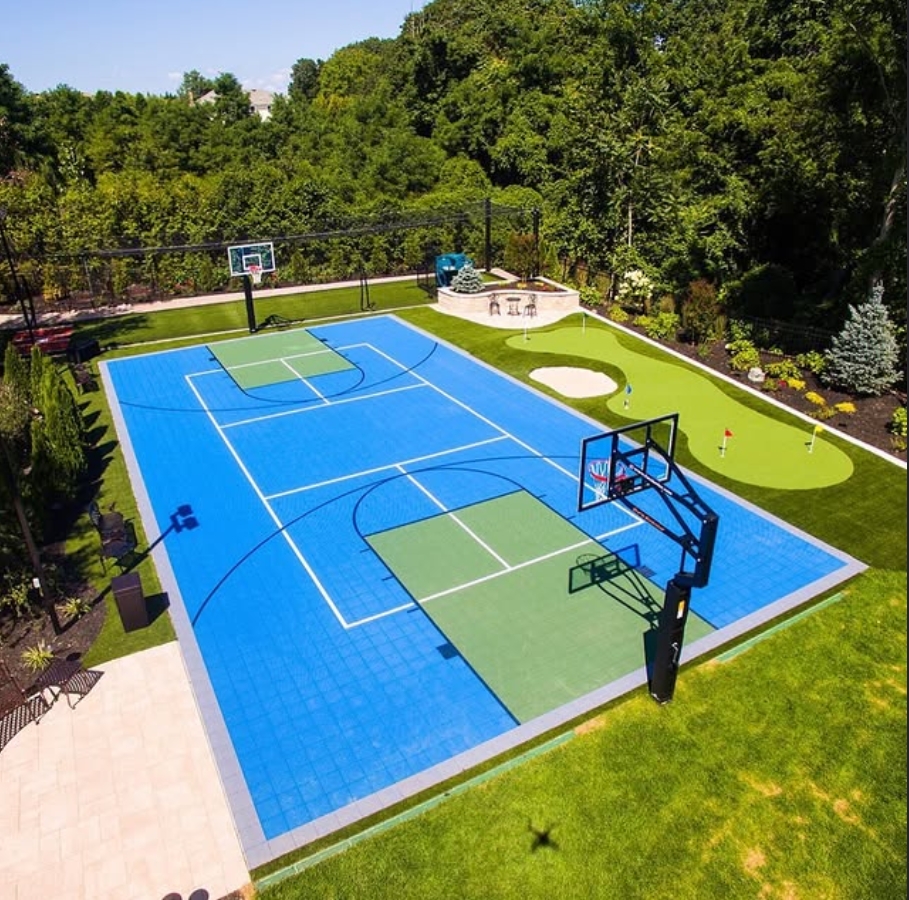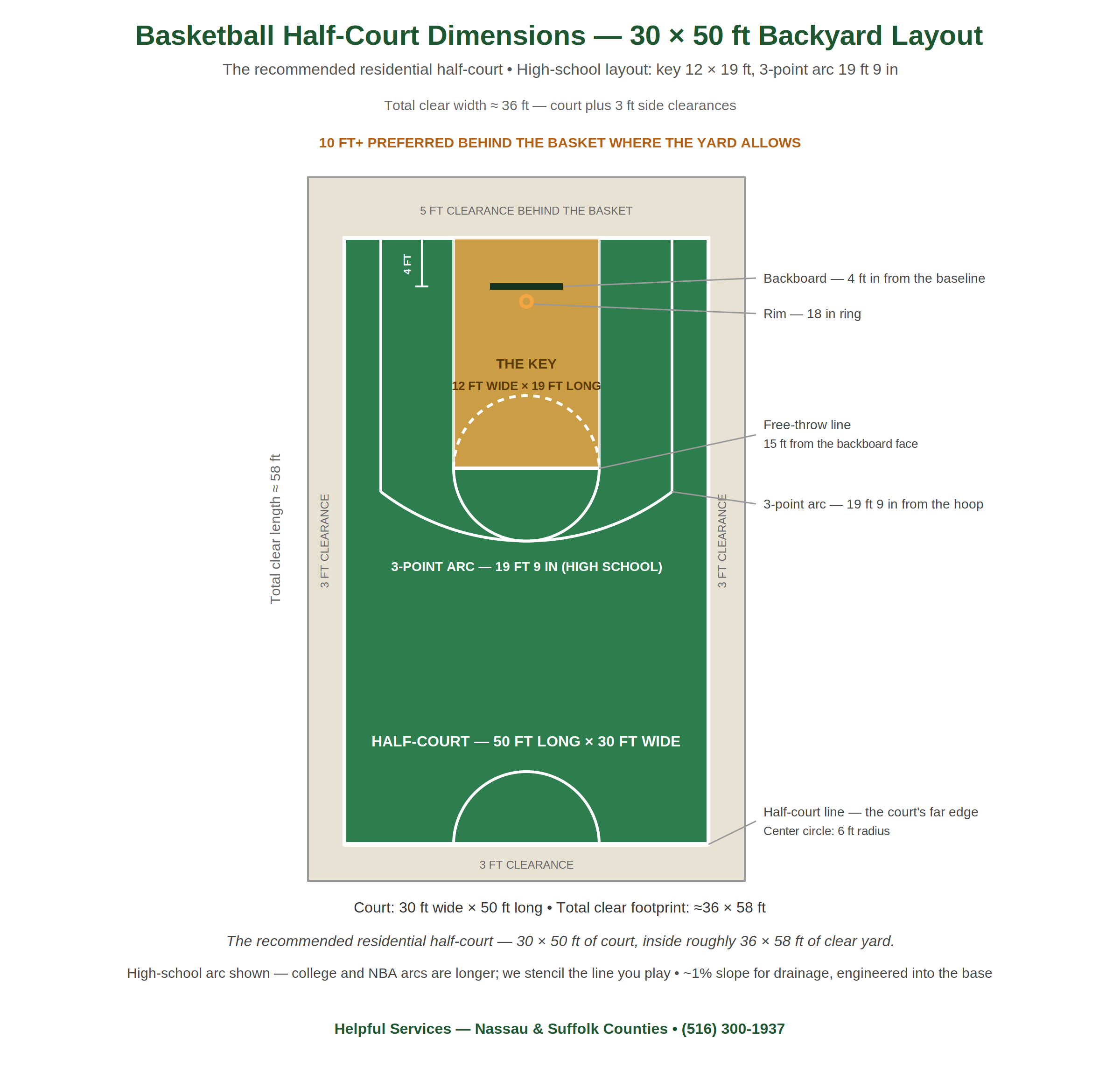
Basketball Court Dimensions: Half-Court Sizes for Long Island Backyards
Last updated: November 2026 A regulation half-court is 47×50 feet. The half-court size we recommend and build most for Long…
Last updated: November 2026
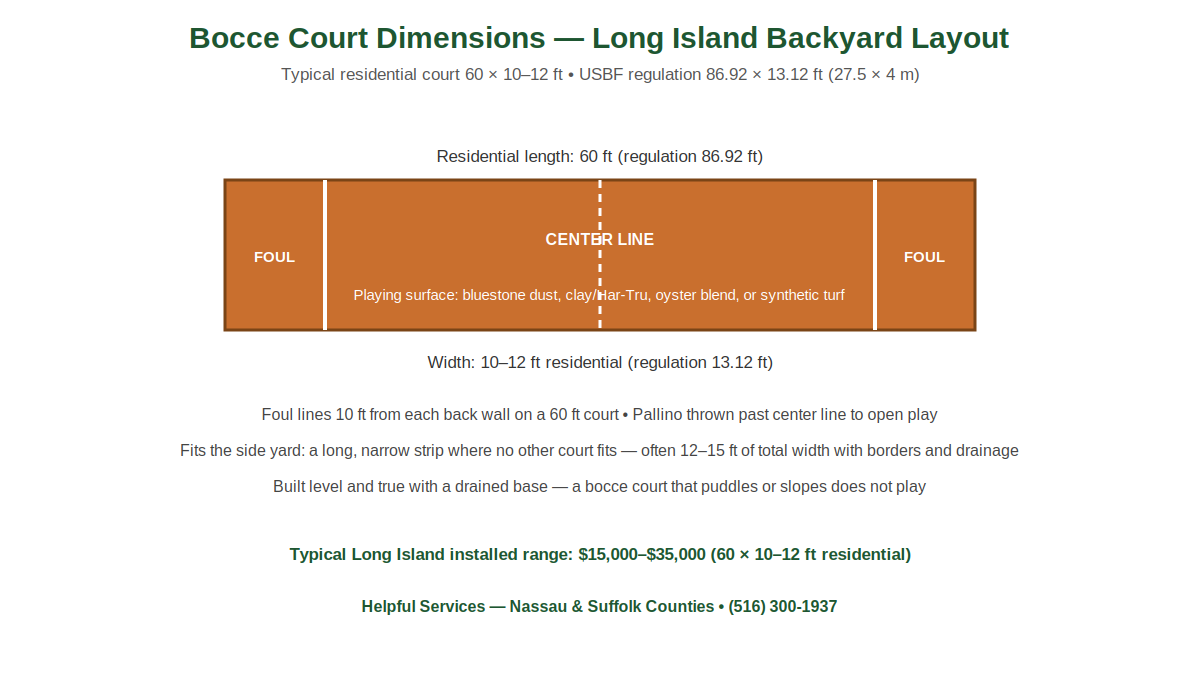
A regulation bocce court is 86.92 × 13.12 feet under United States Bocce Federation rules. Most Long Island homeowners build 60 × 10–12 feet, which plays a full, competitive game and fits a residential yard. A professionally installed residential bocce court on Long Island typically costs $15,000–$35,000, depending on surface, drainage, borders, and lighting.
Consult hours: Monday–Friday 11 AM–7 PM · Saturday 11 AM–3 PM
Bocce scales in a way most court sports do not: a well-built 45-foot court plays honest bocce, and a regulation court is a genuine estate feature. What does not scale is a badly levelled court — the roll tells on every shortcut. Start with the standard you actually play, then check the total footprint your yard really needs.
| Court type | Playing dimensions | Who it’s for |
|---|---|---|
| USBF regulation | 86.92 × 13.12 ft (26.5 × 4 m) — commonly rounded to 87–91 × 13 ft | Competitive and league players; estate lots with room to do it properly |
| League / Special Olympics | 60 × 12 ft | A serious, competitive-feeling court at a residential footprint |
| Residential standard (most popular) | 60 × 10–12 ft | Most Nassau and Suffolk family and estate yards — full-length play that fits a side yard or the long edge of a backyard |
| Compact | 40–50 × 10–12 ft | Tighter lots and narrow side yards, where bocce often fits when no other court sport honestly will |
Homeowners measure the court. Builders measure the court plus everything around it. A 60 × 10 ft court needs roughly a 70–75 × 14–16 ft clear area once borders, standing room at both foul ends, and a side walkway are counted. That footprint check decides, on tighter lots — Manhasset, Garden City, and South Shore properties especially — between a 60 ft court, a compact 40–50 ft court, and a smarter placement along a side yard. Bocce’s long, narrow shape is its superpower on Long Island lots: a 10–13 ft wide strip that is useless for almost anything else is a bocce court waiting to happen.
Choosing your size, honestly: build regulation if you have the lot and play competitively; build 60 × 12 ft for a family backyard — the right answer most of the time; and build compact rather than squeezing a 60 ft court against a fence where nobody can stand to throw.
For the full build — cross-section, surfaces, packages, and permits — see our bocce court construction page for Long Island.
A professionally installed residential bocce court on Long Island typically costs $15,000–$35,000. The table below is the same planning table published on our bocce pillar page, combining the dust/clay and synthetic turf ranges for each size into one band per court type:
| Court | Finished size | Typical Long Island installed range | Best for |
|---|---|---|---|
| Compact | 40–50 ft × 10–12 ft | $10,000–$24,000 | Smaller lots and side yards — Manhasset, Garden City, Massapequa |
| Residential (most popular) | 60 ft × 10–12 ft | $15,000–$35,000 | Most Nassau and Suffolk family and estate yards — Dix Hills, Commack, Syosset, Woodbury, Plainview |
| Regulation | 87–91 ft × 13 ft | $22,000–$50,000+ | Estate lots with room to do it properly — Brookville, Old Westbury, Lloyd Harbor, East End properties |
| Estate / Commercial / HOA | Regulation, double courts, or custom | $30,000–$75,000+ (quoted per project) | Communities, 55+ developments, clubs, parks — and estate courts with seating, shade, and lighting |
Planning ranges only — not a quote. Every Helpful Services quote is site-specific, in writing, and itemised. Within each band, bluestone dust and clay blends sit toward the lower end and synthetic bocce turf toward the higher end: a 60 ft dust court typically runs $15,000–$25,000, and the same court in turf with composite borders typically runs $20,000–$35,000. Hamptons and East End projects carry a travel/minimum-project consideration because of drive time from our Bethpage base — stated up front, before any consult.
| Surface system | Planning range |
|---|---|
| Organic / natural surfaces (bluestone dust, clay blends, oyster blends) | ~$9–$21 per sq ft |
| Synthetic bocce turf (surface only, before base and borders) | ~$9–$11 per sq ft |
| Premium engineered systems (turf over engineered base/foam, masonry borders, drainage, lighting) | ~$24.50–$29.50 per sq ft |
Do not multiply a per-square-foot surface price by your court size and call it a budget. The base, drainage, excavation, and borders underneath the surface are most of the work — and nearly all of what determines whether the court still rolls true in five years.
Every package starts from the same engineered base and drainage standard. The tiers change surface, borders, and finish — never the structure underneath.
What’s included in every Helpful Services bocce quote: site evaluation and court placement, excavation, base and drainage as specified in writing, borders, surface installation and levelling, cleanup, and a final walkthrough where we roll the court with you. Lighting, seating, and surrounding patio or landscape work are separate, clearly labelled line items — never buried.
Illustrative budgets from the tables above — not past projects, not quotes.
A 60 × 12 ft bluestone dust court on a reasonably level, accessible lot: engineered base and drainage, timber borders, dust surface installed, rolled, and levelled. Planning range: $15,000–$25,000.
A 60 × 10 ft synthetic turf court on a lot needing drainage work: engineered base with underdrain, composite borders, bocce turf with foam-underlay option. Planning range: $20,000–$35,000 — before lighting, which is best roughed in during this build if evening play is even a maybe.
Permits and setbacks. There is no single Long Island rule, and any builder who gives you one answer for every town has not pulled permits in yours. A bocce court is generally treated as an accessory or recreational surface; setback distances from side and rear lines differ across the Towns of Oyster Bay, Huntington, Smithtown, and Southampton and incorporated villages such as Garden City, Brookville, and Lloyd Harbor. Lot coverage, waterfront and wetland buffers, drainage changes, and lighting rules can each trigger review, and HOAs commonly require architectural approval. Before we dig, we check your property’s requirements and tell you plainly what applies and what timeline it adds.
Freeze-thaw. A bocce court fails from underneath, never from on top. Long Island winters heave shallow work: water under a thin base freezes, expands, and moves borders and surface with it. Base depth, compaction in lifts, drainage, and border anchoring are all specified for Nassau and Suffolk freeze-thaw and coastal conditions. That engineering is most of what you are paying for, and it is invisible in a finished photo — which is why you should ask any builder, including us, to explain their cross-section in writing.
Drainage and the high water table. Sandy soil that shifts, low South Shore yards, and waterfront properties with a high water table are the three drainage profiles we design for most. The build sequence answers all three the same way: grade the site so water moves away from the court, install underdrains beneath or alongside the base where the property needs them, then build the compacted aggregate base — larger aggregate for structure and drainage, finished with a finer crushed-stone layer, screeded and laser-checked. Standing water is the most common reason Long Island courts fail, and it is a base problem, not a surface problem.
Bocce is an after-dinner game. Integrated low-voltage lighting, designed during the build with conduit and fixture positions installed before surfaces close, lights the full court evenly without glare and ties into your patio and landscape lighting as one system. Retrofitting costs more and looks like a retrofit. See outdoor lighting on Long Island — and ask any builder to show you a court they built with lighting designed in from the start.
A regulation bocce court under United States Bocce Federation rules is 86.92 × 13.12 feet — about 87 × 13 feet, often rounded to 90 × 13 feet. Most Long Island homeowners build 60 × 10–12 feet, which plays as a full, competitive game and fits a residential yard. Compact courts at 40–50 feet long work well on smaller lots.
More than the court’s dimensions. A 60 × 10 ft court needs roughly a 70–75 × 14–16 ft clear area once you count borders, standing room at both foul ends, and a side walkway. We measure the total footprint with you before recommending a size — on tighter lots, a well-placed compact court is the honest answer.
Most professionally installed residential bocce courts on Long Island cost $15,000–$35,000. A standard dust or clay court at 60 × 10–12 ft typically runs $15,000–$25,000; the same court in synthetic turf with composite borders typically runs $20,000–$35,000; regulation builds run $22,000–$50,000+, and estate, commercial, or double-court projects run $30,000–$75,000+. Your yard — access, excavation, and drainage — moves the number more than the surface does.
For most Long Island homeowners, synthetic bocce turf is better in practice: it rolls consistently, drains quickly, needs under half an hour of upkeep a week, and leaves and pine needles blow straight off it. Bluestone dust costs less to install and gives the classic traditional game, but it needs regular raking, rolling, and top-dressing, and it must dry and be groomed after rain before it rolls true. The right answer depends on whether you want to play the court or also tend it.
Sometimes. Setback and accessory-structure rules vary by town and village across Nassau and Suffolk — Oyster Bay, Huntington, Smithtown, Southampton, and the incorporated villages all differ — and lot coverage, waterfront buffers, drainage, and lighting can each trigger review. HOAs often require architectural approval as well. We check the requirements for your specific property before we dig and tell you plainly what applies.
Most residential bocce courts on Long Island take about 1–3 weeks of on-site work once construction starts, depending on excavation, drainage, borders, surface, and weather. Permit or HOA review, where your town or community requires it, happens before that clock starts — we give you a realistic total timeline, including review time, before you commit.
If you know two things — the length you can give a court, and whether your yard holds water after rain — we can tell you on one call which size is honest for your lot and which cost band it lands in. No site-visit fee to find out, and if a bocce court is not the right build for your property, we will tell you that too.
Call (516) 300-1937 — free phone consult, Monday–Friday 11 AM–7 PM · Saturday 11 AM–3 PM
Ready for the full picture — surfaces compared, build cross-section, packages, and community courts? Read the complete bocce court construction guide for Long Island. And if your yard time extends past sunset, see pool and patio lighting for the lighting that makes an evening court work.
Bocce court construction on Long Island · Pickleball court construction on Long Island · Basketball court installation on Long Island · Outdoor lighting on Long Island · Contact Helpful Services