Planning Synthetic Turf or a Putting Green on Long Island: Questions to Settle First
A lawn-like area, a dog run and a putting green start with different priorities. These questions help define the right…

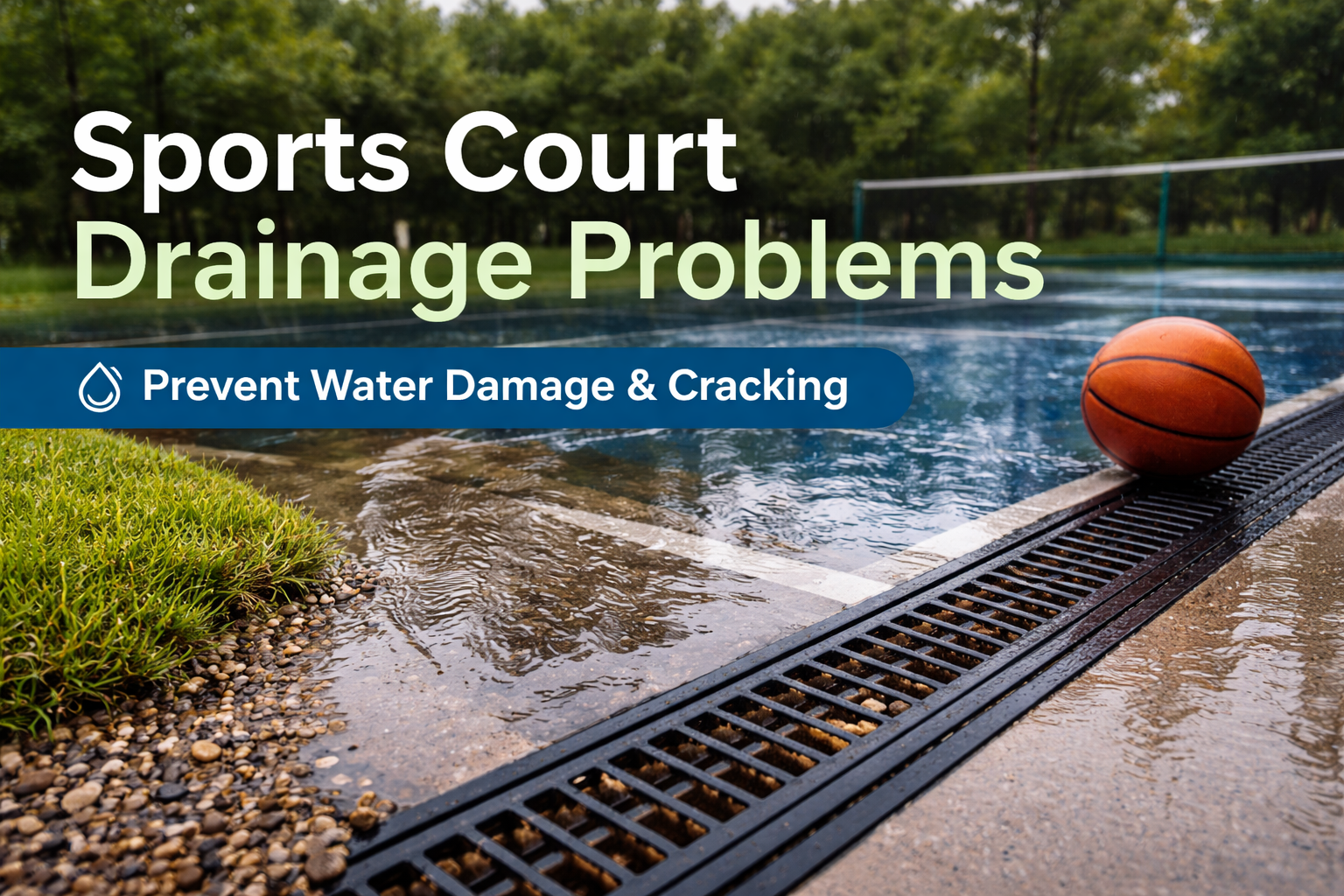
Sports court drainage problems are a leading cause of cracking, uneven surfaces, and early court failure. Learn why drainage matters and how proper planning prevents costly repairs.
When a sports court begins to crack, shift, or deteriorate prematurely, water is almost always involved even if it isn’t visible on the surface.
Drainage issues are one of the most common and most overlooked causes of sports court failure. Many courts look perfectly fine when they’re first installed, only to develop problems after heavy rain, winter freeze-thaw cycles, or a few seasons of use.
Understanding how drainage affects a sports court and why it must be planned before construction can help homeowners avoid costly repairs and repeated resurfacing.
A sports court is a rigid surface. It relies on the stability of everything beneath it to remain level, crack-free, and playable.
When water collects under or around the court structure, it:
Even small amounts of trapped water can lead to long-term issues. Over time, this movement transfers stress to the surface, resulting in cracks, low spots, and uneven bounce.
Drainage problems don’t always appear immediately which is why they’re often misunderstood.
Water doesn’t need to pool on the surface to cause damage. Subsurface water can remain trapped beneath a court if:
This hidden moisture weakens the base over time, especially during colder months when freezing and thawing occur.
Courts must be designed to direct water away efficiently. When slope is improperly planned, water may:
Even minor slope miscalculations can create long-term drainage challenges that are difficult to correct after installation.
Drainage doesn’t stop at the edge of the court. Nearby elements such as:
All influence how water moves across a property. When these factors aren’t considered together, water often finds its way beneath the court structure.
This is why sports court drainage must be evaluated as part of the entire site, not as an isolated feature.
Drainage issues don’t just shorten the lifespan of a court — they affect how it plays.
Common symptoms include:
These issues often worsen over time, even if the surface appears intact initially.
In many cases, homeowners attempt resurfacing to correct these problems. Without addressing drainage, the symptoms usually return.
One of the biggest challenges with drainage is that it must be addressed before the court is built.
Once a court is installed:
This is why proper drainage planning is not an optional upgrade — it’s a foundational requirement.
Effective court drainage is intentional and site-specific. It typically includes:
Properly graded base layers
There is no universal solution. What works on one property may fail on another.
This is why drainage design should always be based on site evaluation, not assumptions.
The most successful sports courts are planned with drainage in mind from the very beginning.
That planning includes:
When drainage is treated as a core design element, courts perform more consistently and require fewer repairs over time.
Drainage problems are rarely visible until damage has already occurred. By the time cracks or uneven areas appear, the underlying issue is often well established.
For homeowners considering a new sports court — or evaluating repairs to an existing one — understanding drainage early can prevent unnecessary costs and frustration later.
If you’re in the planning phase, our Court Planning Checklist outlines the most important considerations for building a durable, well-performing sports court — including drainage, base preparation, and site evaluation.
Download the Court Planning Checklist to make informed decisions before you build or repair.