Helpful Services designs and builds backyard pickleball courts across Nassau and Suffolk Counties on Long Island. A regulation court is 20×44 feet of play on a 30×60-foot pad. Most Long Island backyard pickleball courts cost $28,000–$65,000 installed, depending on base, surface, fencing, and lighting. Free phone consult: (516) 300-1937.
Call (516) 300-1937 | Request a Free Phone Consult
Free phone consult hours: Monday–Friday 11 AM–7 PM, Saturday 11 AM–3 PM
Design-build, one partner from first walk to first game · Base, drainage, surface, lighting, and fencing handled as one engineered system · Serving Nassau & Suffolk Counties from our Bethpage base · Courts led by a founder with 15+ years building sports courts on Long Island
Pickleball is easy to learn. A pickleball court is not easy to build well — especially on Long Island.
Our freeze-thaw winters, sandy and clay pockets, high water tables near the shores, and tight town setback rules punish shortcuts. A court poured on a thin, poorly drained base will puddle, heave, crack, and peel — usually within the first few seasons. A court built on a properly excavated, compacted, and drained base plays true for years and only needs its colour coats refreshed.
That is the difference we build on. At Helpful Services, we treat a pickleball court as an engineered outdoor structure, not a slab with lines painted on it:
Helpful Services owner Vincent has spent 15+ years building sports courts on Long Island, and built the sports courts program at his prior company before founding Helpful Services. That program-building experience — base systems, surface selection, what survives Long Island winters and what does not — is the standard every Helpful Services court is built to today. We will happily walk you through that experience on a consult call, and we will only ever show you Helpful Services projects as Helpful Services projects.
All ranges in this section are typical Long Island ranges for a quality residential build, published for planning purposes. Your fixed price comes after a site walk, in writing. Site access, slope, drainage, tree work, base choice, surface choice, fencing, and lighting move every number — honestly, in both directions.
Most new backyard pickleball courts on Long Island cost $28,000–$65,000 installed. Premium estate courts with lighting, fencing, custom colours, and landscape integration typically run $70,000–$110,000 or more. Converting a sound existing tennis or basketball court is the lower-cost route, typically $8,000–$20,000.
| Build type | Typical Long Island range | What is included |
|---|---|---|
| Resurfacing / conversion of an existing tennis or basketball court | $8,000–$20,000 | Crack repair, acrylic resurfacer and colour coats, pickleball lines, net system |
| New asphalt court, acrylic surface | $28,000–$45,000 | Excavation, recycled concrete aggregate / compacted sub-base, asphalt, acrylic colour system, lines, permanent net |
| New concrete / post-tension court, acrylic surface | $40,000–$65,000 | Excavation, drainage, post-tension or reinforced concrete pad, acrylic colour system (cushioned option below), lines, premium net |
| Premium / estate court | $70,000–$110,000+ | Everything in the concrete build, plus LED court lighting, fencing or windscreen, custom colours or logo, landscaping, seating, and patio integration |
For context only: finished courts on Long Island run roughly $16–$36 per square foot of pad. That figure is useful for comparing proposals — it is not a quote, and any builder quoting a court sight-unseen from a per-square-foot number has not looked at your drainage, access, or slope.
Resurfacing / conversion of an existing tennis or basketball court. Includes crack repair, acrylic resurfacer and colour coats, pickleball lines, and a net system.
New asphalt court with an acrylic surface. Includes excavation, recycled concrete aggregate / compacted sub-base, asphalt, acrylic colour system, lines, and a permanent net.
New concrete / post-tension court with an acrylic surface. Includes excavation, drainage, post-tension or reinforced concrete pad, acrylic colour system, lines, and a premium net. Cushioned acrylic upgrade is +$3,000–$6,000.
Premium / estate court. Includes everything in the concrete build, plus LED court lighting, fencing or windscreen, custom colours or logo, landscaping, seating, and patio integration.
| Add-on | Typical Long Island range | Notes |
|---|---|---|
| LED court lighting | $8,000–$18,000 | Poles, fixtures, wiring, and controls — see the Lighting section below |
| Fencing | $6,000–$14,000 | Typically 10 ft at the back, 4–6 ft at the sides; material and gates affect price |
| Cushioned acrylic upgrade | +$3,000–$6,000 | Added cushion layers under the colour coats — easier on knees and joints |
| Modular tile surface (interlocking tile over a concrete pad) | Quoted per design | Price depends on tile system, colours, and layout — priced in your written scope |
Our promise on pricing: Every quote is a fixed written scope after a site walk — pad size, base build-up, surface system, net, fencing, and lighting itemised. No allowances hidden in fine print, and no surprise change orders for conditions we could see on the walk.
Get your fixed written scope — call (516) 300-1937, Mon–Fri 11–7 / Sat 11–3
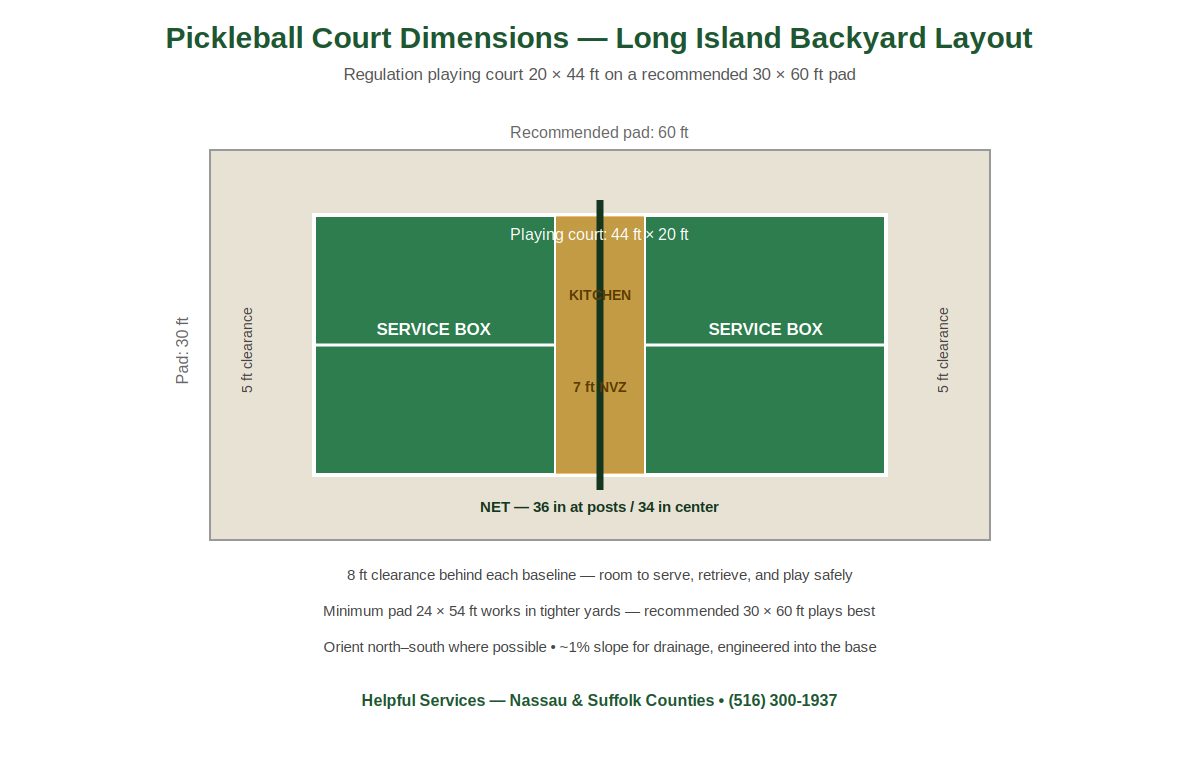
A pickleball court is smaller than most people expect — and the space around it matters as much as the court itself.
| Specification | Dimension / standard |
|---|---|
| Playing area | 20 ft wide × 44 ft long |
| Non-volley zone ("the kitchen") | 7 ft on each side of the net |
| Net height | 36 inches at the posts, 34 inches at the centre |
| Minimum total area (tight yards) | 24 ft × 54 ft — workable, with reduced run-back space |
| Recommended total pad | 30 ft × 60 ft — comfortable run-back and sideline room |
| Orientation | North–south, so neither side stares into low sun |
| Slope for drainage | Approximately 1% — enough to shed water, never enough to feel in play |
| Clear space above and around | Allow for lighting pole placement and setbacks — confirmed town by town in the Permits section below |
Many Nassau and Suffolk lots cannot fit a full 30×60 pad once setbacks are applied — particularly in villages such as Garden City and Manhasset, where the lots are valuable but tighter. Options we design regularly:
We will measure, check setbacks, and tell you plainly if a full court does not fit your lot. A compact court designed honestly plays better than a regulation court squeezed where it should not go.
Basketball court installation on Long Island | Bocce ball court construction on Long Island
The surface is what you see and feel. The base is what decides whether the surface still plays well in five winters. Here is both, compared honestly.
| Asphalt + acrylic | Concrete / post-tension + acrylic | Cushioned acrylic | Modular tile over concrete | |
|---|---|---|---|---|
| How it plays | True, consistent ball response; the standard club-style surface | True, consistent ball response on the most stable platform | Same true response, noticeably softer underfoot | Slightly different, faster feel; excellent drainage through the tile |
| Comfort | Firm — standard play | Firm — standard play | Easiest on knees and joints of the acrylic options | Good shock absorption depending on tile system |
| Freeze-thaw on Long Island | Good when the base and drainage are right; asphalt flexes slightly with temperature | Best long-term stability; post-tension resists cracking from ground movement | Same platform benefits as its concrete base | Tiles expand and contract by design; pad quality underneath still decides everything |
| Lifespan / resurfacing | Acrylic colour coats typically refreshed every 5–8 years | Longest pad life; acrylic coats refreshed every 5–8 years | Cushion system recoated on a similar cycle; cushion layers add life to the finish | Tiles are individually replaceable; no recoating cycle |
| Relative cost | Lowest cost for a new build | Higher — the premium platform | Concrete cost + $3,000–$6,000 upgrade | Quoted per design |
| Best for | Most backyard courts — the proven value build | Estate courts, problem soils, owners building once for decades | Players with joint concerns, heavy daily play | Owners who want colour design and a replaceable playing surface |
Brand note: we install professional acrylic colour systems and modular tile systems selected for your design and budget, and we name the exact system in your written scope before you sign — never a generic "court paint" line item.
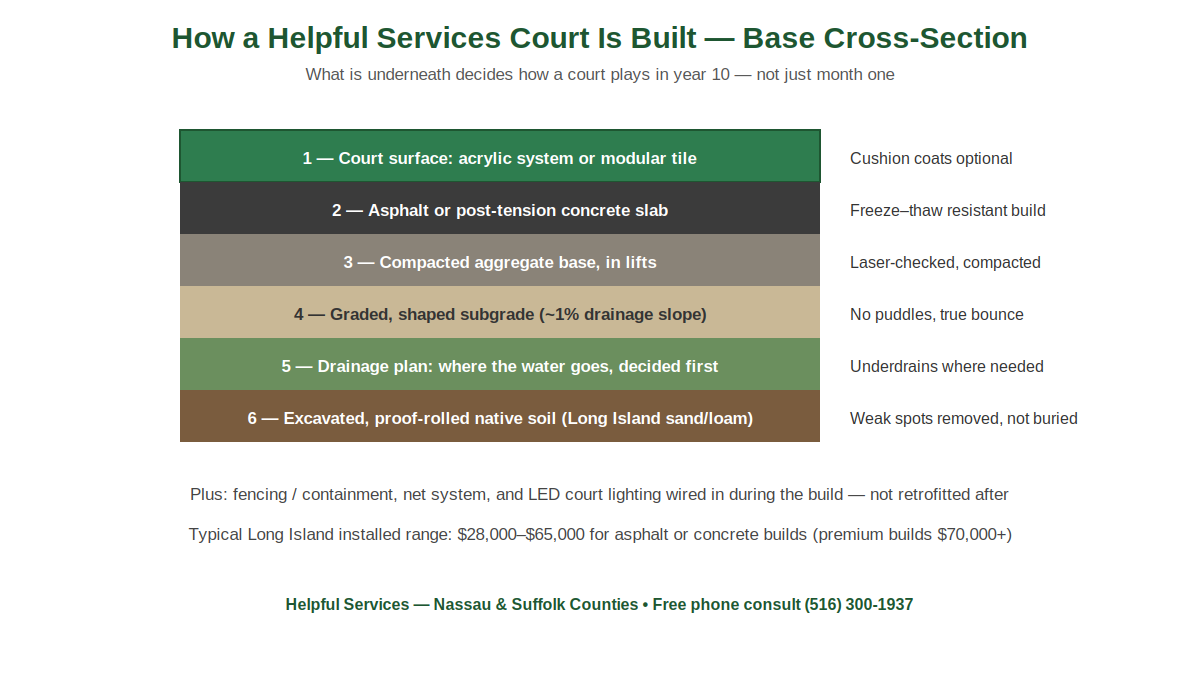
This is the part of the job you will never see after week one, and the part that matters most:
If a competing proposal does not specify excavation depth, sub-base material, and drainage, you are not comparing two courts. You are comparing a court with a painted slab.
Free phone consult first, then a site walk. We talk through how you play, who plays, and what else the yard needs to do. On the site walk we measure the available area, check slope, soil, drainage, trees, access, and town setbacks, and flag permit questions before any design is drawn.
You get a layout — pad size and orientation, base build, surface system and colours, net and fencing, and lighting if you want evening play — with a fixed written scope and price. Changes happen here, on paper, where they are free.
We prepare and file what your town requires (see the Permits section below) and build the permit timeline into your schedule honestly. Permit timing is the one part of a court build no builder controls, and any builder who guarantees it is guessing with your summer.
Excavation, drainage, sub-base, and pad — then cure time, respected in full. Once the pad is ready and the weather window is right: surface system, lines, net, fencing, and lighting. One crew lead, regular updates, and a site kept clean and respectful of your home throughout.
Typical build window: once permits are clear and the pad work begins, most residential courts take several weeks of active build time, plus the pad's required cure time before surfacing. Your written scope states your project's specific sequence and expected window.
Final walkthrough together, net tension and lines checked, lighting aimed and controls set, and a simple care guide: how to clean the surface, what to watch for, and when to call us. We remain available after completion for resurfacing, repairs, and the next project — that is the point of one partner for the whole property.
Start with Step 1 — free phone consult (516) 300-1937, Mon–Fri 11 AM–7 PM / Sat 11 AM–3 PM

Most court builders treat lighting as a line item. Outdoor lighting is one of our core businesses. That changes what your court is like at 7:30 PM in September.
A pickleball court without lighting is a court you use at noon in June. A properly lit court is the most-used space in your yard — after dinner, after work, well into the fall.
LED court lighting typically adds $8,000–$18,000 to a court build on Long Island, depending on poles, fixtures, wiring runs, and controls — itemised in your written scope.
Outdoor lighting installation on Long Island | Pool & patio lighting
This section is general guidance, not legal advice. Rules change, and they change town by town. Confirming your property's rules is part of our Evaluate & Plan step, before you spend on design.
Honest bottom line: permit timing is real, it varies, and it is worth doing correctly. A court built without required approvals risks fines and forced removal — a risk no schedule saving justifies.
We build pickleball courts across Nassau and Suffolk Counties. Our priority areas, chosen for lot size, court feasibility, and the families building there, include:
Gold Coast & North Shore: Dix Hills, Brookville and Upper Brookville, Old Westbury, Syosset and Muttontown, Manhasset and Plandome, Lloyd Harbor and Huntington, Cold Spring Harbor, Oyster Bay and Cove Neck, Locust Valley, Roslyn and Roslyn Harbor, East Hills, Great Neck, Woodbury, and Jericho.
High-volume family suburbs: Commack, Massapequa and Massapequa Park, Plainview and Old Bethpage, Northport and East Northport, Sea Cliff, and our home base of Bethpage.
The Hamptons & East End (selective, premium projects): Southampton, Water Mill, Sagaponack, Bridgehampton, Wainscott, East Hampton, Amagansett, Quogue, and Sag Harbor. Hamptons projects carry minimum project sizes and are scheduled to account for East End travel — ask on your consult call and we will quote it plainly.
Do not see your town? If you are in Nassau or Suffolk, call — the list above is a priority list, not a boundary.
All sports court services on Long Island
"Our first dedicated pickleball builds under the Helpful Services name are being scheduled now. Until those courts are finished and photographed, we would rather show you our basketball and multi-sport court work — labelled honestly as what it is — than borrow anyone else's portfolio. Ask on your consult call and we will walk you through the court projects we can show you today."
Synthetic turf & putting greens on Long Island | Masonry, patios & walkways on Long Island
Most new backyard pickleball courts on Long Island cost $28,000–$65,000 installed — $28,000–$45,000 for a new asphalt court with an acrylic surface, and $40,000–$65,000 for a concrete or post-tension court. Premium estate courts with LED lighting, fencing, and landscape integration typically run $70,000–$110,000 or more. Converting a sound existing court typically costs $8,000–$20,000. These are typical Long Island ranges; your fixed price is set in a written scope after a site walk.
The playing area is 20×44 feet. Plan on a 30×60-foot pad for comfortable run-back and sideline space. A 24×54-foot area is the minimum that works in a tight yard, with less room behind the baselines. Setbacks in your town then decide where that pad can sit — we measure and check this on the site walk before any design is finalised.
Usually, yes — most towns require permits for a new court pad and grading, for fencing above certain heights, and for the electrical work behind court lighting. Rules, setbacks, and lot coverage limits vary by town and, in some places, by village. We check your property's rules and handle the filings as part of the project; permit timing is built into your schedule honestly, because no builder controls a town's review calendar.
Both work when the base and drainage are built correctly. Asphalt is the lower-cost new-build platform and flexes slightly with temperature changes. Concrete — especially post-tension concrete — costs more, offers the longest pad life, and best resists cracking from the ground movement and freeze-thaw cycles we get on Long Island. For most backyards, asphalt plus acrylic is the proven value build; for estate courts and problem soils, we recommend concrete. Your site walk recommendation will say which, and why, in writing.
Once permits are clear, most residential courts take several weeks of active build time — excavation, base, and pad first, then the pad's required cure time, then surfacing, lines, net, fencing, and lighting in the correct weather window. Cure time is not optional: surfacing a pad too early is how courts peel. Permit review time before the build varies by town and is the least predictable part of the schedule.
Yes, if the existing pad is structurally sound. Conversion typically runs $8,000–$20,000 on Long Island and includes crack repair, an acrylic resurfacer and colour coats, pickleball lines, and a net system. If the existing pad has failed base or drainage problems, honest advice may be to rebuild rather than resurface — we will show you what we find and price both routes where both are real options.
Yes — multi-sport design is one of the most practical builds on Long Island, especially where lot size limits you to one pad. We stripe the pad for both games, install an adjustable basketball hoop, and use a multi-sport net system that sets to pickleball height or removes for full-court basketball. You choose court colours and line colours so both games read clearly without visual clutter.
Basketball court installation on Long Island
Cushioned acrylic — additional cushion layers built under the colour coats on a concrete or asphalt pad — is the easiest on knees and joints of the acrylic options, typically adding $3,000–$6,000 to a build. Modular tile over a concrete pad also offers good shock absorption, depending on the tile system. If joint comfort is a priority because you play daily, raise it on the consult call and we will design for it from the start rather than treating it as an upgrade at the end.
Neither is required to play, and both change how much you actually use the court. Fencing — typically 10 feet at the back and 4–6 feet at the sides — keeps balls in play and out of plantings and pools; it typically costs $6,000–$14,000. LED lighting, typically $8,000–$18,000, extends play into the evening, which for most working families is when the court gets used most. We design lighting with shielded fixtures and glare control so evening play does not come at the cost of your neighbours' goodwill.
Day to day, maintenance is simple: keep the surface swept or blown clear of leaves and grit, rinse it as needed, and keep standing water, snow shovels with metal edges, and pressure-washing at close range off it. In winter, let snow melt naturally rather than chipping ice. Acrylic colour coats on Long Island typically need refreshing every 5–8 years depending on use, sun, and shade. Cracks should be assessed early — small cracks are a maintenance item, ignored cracks become a base question. We remain available for resurfacing and repairs on courts we build.
We will not promise a specific return, because no honest builder can. What is fair to say: in the Nassau and Suffolk neighbourhoods where we build — where outdoor living space is a major part of how a home is used and sold — a well-built, well-lit court integrated with the patio, turf, and landscaping is a finished outdoor amenity, and finished outdoor amenities are consistently part of how premium homes on Long Island present. A cracked, puddling court adds nothing. Build quality is the difference, which is why the base matters more than the paint.
Across Nassau and Suffolk Counties on Long Island. Our priority areas include Dix Hills, Brookville, Old Westbury, Syosset and Muttontown, Manhasset, Huntington and Lloyd Harbor, Cold Spring Harbor, Oyster Bay, Locust Valley, Roslyn, East Hills, Great Neck, Garden City, Woodbury, and Jericho; family suburbs including Commack, Massapequa, Plainview, and Northport; and, for premium projects, Southampton, Water Mill, and the wider Hamptons. If your town is not listed and you are in Nassau or Suffolk, call (516) 300-1937 — the list is a priority list, not a boundary.
Start with a free phone consult. We will talk through your yard, your town's setbacks, the build routes that fit your lot, and the typical Long Island range your project is likely to fall in — and if a full court does not fit, we will tell you that on the call and talk through what would: a compact layout, a multi-sport court, or a bocce court down the side yard.
Free phone consult hours: Monday–Friday 11 AM–7 PM · Saturday 11 AM–3 PM
Call (516) 300-1937 | Request a Call Back via Our Contact Form
Helpful Services LLC · Bethpage, NY · Serving Nassau & Suffolk Counties on Long Island · [email protected]