Pickleball Court Cost on Long Island (2026)
Last updated: November 2026 Most new backyard pickleball courts on Long Island cost $28,000–$65,000 installed for a regulation 20×44-foot court…


Last updated: November 2026
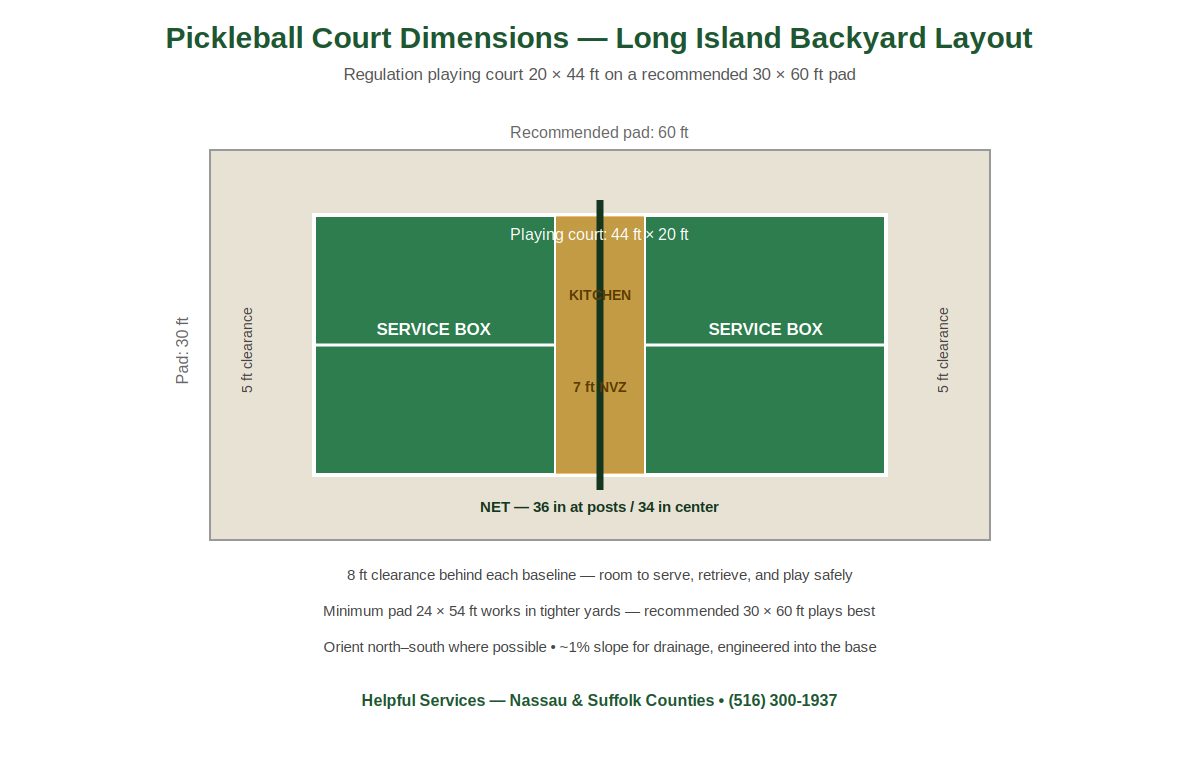
Most new backyard pickleball courts on Long Island cost $28,000–$65,000 installed for a regulation 20×44-foot court on a 30×60-foot pad — $28,000–$45,000 in asphalt with an acrylic surface, or $40,000–$65,000 in concrete or post-tension concrete. Converting an existing court typically costs $8,000–$20,000, and premium estate courts run $70,000–$110,000 or more.
Free phone consult: (516) 300-1937
Consult hours: Monday–Friday 11 AM–7 PM · Saturday 11 AM–3 PM
National cost guides average courts built everywhere, on every kind of lot, to every standard. Long Island is not the average case: labour costs are higher, town permitting is real, lots are often tight or sloped, and freeze-thaw winters punish thin bases — so a court built to last here costs more than a national average, and lasts longer for it.
The ranges below are the typical Long Island ranges we publish on our pickleball court construction page, for a quality residential build. They are planning ranges, not quotes. Your fixed price comes after a site walk, in a written scope that itemises the pad, the base build, the surface system, the net, and any fencing or lighting — so you can compare our number against any other proposal line by line.
One warning before the tables: do not budget from a per-square-foot number alone. Finished courts on Long Island run roughly $16–$36 per square foot of pad, but that spread is so wide because the things that decide your price — base, drainage, access, slope — are not in the square footage. A builder who quotes a court sight-unseen from a square-foot rate has not looked at your yard.
All ranges are for a standard 30×60-foot pad unless noted.
| Build type | Typical Long Island range | What’s included |
|---|---|---|
| Resurfacing / conversion of an existing tennis or basketball court | $8,000–$20,000 | Crack repair, acrylic resurfacer and colour coats, pickleball lines, net system |
| New asphalt court, acrylic surface | $28,000–$45,000 | Excavation, recycled concrete aggregate / compacted sub-base, asphalt pad, acrylic colour system, lines, permanent net |
| New concrete / post-tension court, acrylic surface | $40,000–$65,000 | Excavation, drainage, post-tension or reinforced concrete pad, acrylic colour system (cushioned option below), lines, premium net |
| Premium / estate court | $70,000–$110,000+ | Everything in the concrete build, plus LED court lighting, fencing or windscreen, custom colours or logo, landscaping, seating, and patio integration |
Most courts are not bought bare. These are the additions homeowners ask about most, at the same typical Long Island ranges published on our pillar page:
| Add-on | Typical Long Island range | Notes |
|---|---|---|
| LED court lighting | $8,000–$18,000 | Poles, fixtures, wiring, and controls. The single biggest change to how much a court gets used — for most working families, evening is when the court is played. |
| Fencing | $6,000–$14,000 | Typically 10 ft at the back, 4–6 ft at the sides; material and gates affect price |
| Cushioned acrylic upgrade | +$3,000–$6,000 | Added cushion layers under the colour coats — the easiest acrylic surface on knees and joints |
| Modular tile surface (interlocking tile over a concrete pad) | Quoted per design | Depends on tile system, colours, and layout — priced in your written scope, never estimated from a brochure rate |
Notice what is not an add-on: excavation, drainage, sub-base, and the pad itself. Those are the court. Any proposal that prices the surface and treats the base as an optional extra is pricing half a court.
Two courts of identical size on the same street can land $15,000 apart. These are the factors that move the number, in roughly the order they matter:
In most Nassau and Suffolk towns, a new court pad, grading, fencing above certain heights, and the electrical work for court lighting require permits or approvals. Setbacks and maximum lot coverage decide where a 30×60 pad can sit — and on some lots, whether it fits at all. Some villages add their own review on top of town rules. We check your property’s rules against your survey during the planning step and handle the filings as part of the project. Any builder who guarantees you a permit timeline is guessing: towns set their own review calendars, and honest schedules say so.
Long Island winters cycle across freezing dozens of times a season. Water in a thin or poorly drained base expands as it freezes, heaves the pad, and cracks the surface above it. This is why our base standard — excavation to the depth your soil requires, drainage designed in, and a compacted recycled concrete aggregate sub-base placed in lifts — is not where we cut to win a bid. A court resurfaced after five winters because the base failed costs more than a court built right once. When you compare quotes, ask every builder to specify excavation depth, sub-base material, and drainage in writing. If a proposal won’t, you are not comparing courts.
A pickleball court is a large, flat, impermeable surface placed in the middle of a yard that used to absorb rain. Where that water goes now — off the pad at roughly a 1% slope, away from foundations, plantings, and your neighbours — has to be designed, not discovered after the first storm. South Shore and waterfront lots with high water tables need this conversation most, and earliest.
For the full build standard behind these numbers — base build-up, surface comparison, lighting design, and town-by-town permit notes — see our pickleball court builders page for Long Island.
Illustrative budgets built from the tables above, so you can see how the rows combine. These are planning examples, not past projects and not quotes.
A sound existing tennis court, resurfaced for pickleball: crack repair, acrylic resurfacer and colour coats, lines, and a net system. Planning range: $8,000–$20,000.
A new 30×60 asphalt court with an acrylic surface, permanent net, and fencing — no lighting at build time, with lighting roughed in for later. Court $28,000–$45,000 plus fencing $6,000–$14,000. Planning range: roughly $34,000–$59,000.
A new 30×60 post-tension concrete court with cushioned acrylic, LED lighting, fencing, and patio integration. Court $40,000–$65,000, plus the cushioned upgrade $3,000–$6,000, lighting $8,000–$18,000, and fencing $6,000–$14,000, before landscape finish work. Planning range: roughly $57,000–$103,000+, landing in the $70,000–$110,000+ premium band once integration work is included.
The pattern to notice: the pad and surface set the floor of the budget. The finish decisions — cushion, light, fence, landscape — set the ceiling.
Most new backyard pickleball courts on Long Island cost $28,000–$65,000 installed — $28,000–$45,000 for a new asphalt court with an acrylic surface, and $40,000–$65,000 for a concrete or post-tension court. Premium estate courts with LED lighting, fencing, and landscape integration typically run $70,000–$110,000 or more. Converting a sound existing court typically costs $8,000–$20,000. Your fixed price is set in a written scope after a site walk.
Because size is only one variable. Base choice (asphalt versus concrete or post-tension), drainage needs, slope and retaining, site access, tree work, fencing, and lighting each move the price — often by more than the surface does. Two 30×60 courts can honestly differ by $15,000 or more. Compare written scopes line by line: pad size, excavation depth, sub-base, surface system, and what is included.
Usually, yes — if the existing pad is structurally sound. Conversion typically runs $8,000–$20,000 on Long Island, covering crack repair, an acrylic resurfacer and colour coats, pickleball lines, and a net system. If the existing base or drainage has failed, resurfacing only delays a rebuild, and honest advice may be to rebuild. A site walk can price both routes where both are real options.
LED court lighting typically adds $8,000–$18,000, depending on poles, fixtures, wiring runs, and controls. Fencing typically adds $6,000–$14,000, usually 10 feet at the back and 4–6 feet at the sides. Neither is required to play, and both change how much the court is used: lighting extends play into the evening, and fencing keeps balls in play and out of plantings and pools.
Usually, yes. Most Nassau and Suffolk towns require permits for a new court pad and grading, for fencing above certain heights, and for court-lighting electrical work. Setbacks and lot coverage limits decide where the pad can sit, and some villages add their own review. Permit fees themselves are modest next to the build; the real cost factor is design — a pad that must shrink, move, or gain retaining to satisfy setbacks changes the scope. We check the rules for your property before design is finalised.
Decide the base first and do not cut it — it is the one part that cannot be upgraded later without rebuilding. Then phase the finish: build the court and fencing now, and have lighting roughed in during the build so it can be added later without tearing up the pad. Choose standard acrylic over cushioned unless joint comfort is a priority. And get a fixed written scope: the most common way court budgets blow up is a low headline price that excluded drainage, access work, or finish items discovered mid-build.
Ranges plan a project; they do not price one. Start with a free phone consult: we will talk through your yard, your town’s setbacks, the build route that fits your lot, and the range your project is likely to land in — and if a full court does not fit your property, we will tell you that on the call and talk through compact, multi-sport, and bocce alternatives.
Call (516) 300-1937 — free phone consult, Monday–Friday 11 AM–7 PM · Saturday 11 AM–3 PM
Call (516) 300-1937 Request a Call Back via Our Contact Form
Planning the whole backyard, not just the court? A court plays best when the walk to it is lit and the space around it is finished. See how we design outdoor lighting on Long Island — including the court lighting in the table above, designed as one system with your pathway, patio, and landscape lighting.
Also see our basketball court and pickleball court construction pages for related court builds.